Welcome to our website

Yoga (Sanskrit, Pāli: योग yóga) refers to traditional physical and mental disciplines that originated in India.[1] The word is associated with meditative practices in Hinduism, Buddhism and Jainism.[2][3][4] Within Hinduism, it refers to one of the six orthodox (āstika) schools of Hindu philosophy, and to the goal towards which that school directs its practices.[5][6] In Jainism, yoga is the sum total of all activities — mental, verbal and physical.

Friday, January 29, 2010

YOGA POSTURES: Standing Position

Standing Alignment in Yoga: Asana is a Sanskrit word. It means to keep our body in a particular posture. Many yogis have devised these whole set of asanas, the postures. One of the great Yogis was Patanjali who had devised many postures, which were easy and comfortable. His teaching is known as Astang Yoga, too.
Yoga-21Most of the postures are devised to enable us to have better physical health and a peaceful mind. These yoga postures have deep impact on our whole body, and mind and soul. The yoga postures help keeping us in a particular physical position.

The meaning of word 'Nataraj' is 'The Lord of Dancing'. Lord Shiva is believed to be the Nataraj. In fact the Natarajanasan is believed to be of difficult type of Yoga Postures. Yoga is one of the most useful and widely practiced exercise. It has been originated in India. Yoga or doing of the yoga postures, the yoga asanas, is famous for its spiritual touch. These postures provide extreme stretches to the human body. Yoga is one of the six schools of Hindu philosophy, but now a day it is practiced all over the world. Some use it as exercises for remain healthy and fit, and the rest for spiritual reasons.

Trikonasan, Triangle Pose: The word 'Trikona' means triangle. As our body looks like a triangle in this yoga posture this asana is called Trikonasana, the triangle pose. It is an important pose (asana) in Hatha yoga system of yoga exercises. This pose is done twice, in sequence. Once it is done by facing the left and another facing right.

Ustrasana, Camel Pose
: Whle we do this posture our whole front body is stretches. the front of the body including the chest, abdomen, and quadriceps are stretched to their bearable limit. By doing so regularly for a period, we can improves the flexibility of our spinal cord and the area surrounding the spinal cord. It would those more who are suffering from mild backache. Camel Pose is beneficial in hip disorder, too.

Benefits by doing Standing Yoga Poses

It is necessary to know that the standing position provide us the knowledge about the principles having a proper alignment of our body. Here are some of the Yoga Asanas, the postures, which can be termed as Yoga Postures in Standing Positions. These postures would affect different systems of human body: muscular, respiratory, circulation, digestive, excretory, reproductive, endocrine, nervous system. These asanas are to be performed after keeping our body in standing position: legs together (fully stretched), spine erect and both hands resting on our sides.

Wearing The Yoga Clothes
WYoga at the beachhile doing these postures you need feeling comfortable. So the importance of clothes increases. Yoga clothes are the outfits absorbing your sweat easily, as yoga exercise is bound to make you sweating heavily.

Yoga at the Beach

For women the outfits would be mainly same as the men. But wearing the shorts would be better, as it would help you knowing about how your legs and feet align during the yoga exercise. To cover the breasts fully is essential; for that women can use short bra made from cotton. The women yoga practitioners desiring to enjoy freedom of movement wear bikini while doing yoga postures. It is comfortable especially when you do yoga in open or at beach. (Image Yoga at the Beach Courtesy By karpidis (originally posted to Flickr as Yoga at the beach)[see page for license], from Wikimedia Commons) (Image Natarajasana, The Dance Pose courtesy By Sri Devi Nrithyalaya (http://www.sridevinrithyalaya.org/gallery2.html) [GFDL 1.2], from Wikimedia Commons )

Thursday, January 21, 2010

YOGA POSTURES: Sitting Position

Padmasana femininoSitting Alignment in Yoga : Asana is a Sanskrit word meaning to keep our body in a particular posture. The great Yogi Patanjali had devised many asanas, the postures, which were steady and comfortable. His teaching is known as Astang Yoga, too. Most of the postures are practiced to achieve better physical and mental health, as these yoga postures have deep impact on our body, mind and soul.


The meaning of ‘Padma’, a Sanskrit word, is lotus. While sitting in this posture, the human body looks like a lotus. Thus it is named ‘Padma Asana’. Padmasana is basic posture for many yogic acts. If you want to do chanting for longer hours it is convenient to sit in this asana. As narrated by Patanjali, sitting in this posture makes the energy of human body takes it natural shape, helping to heal several disorders in the body. It is believed that those who practice Padmasana would get help in awaking Kundalini.

Sitting Yoga Postures


VAJRA ASANA,The Thunderbolt Yoga Posture : It has been noticed that regular practice of this asana increases the secretion from the glands, which are vital for the physical and mental health of a person. Along with other benefits of doing Yogic posture, Vajrasana, the Thunderbolt Yoga Posture helps the digestion process and assists in eliminating the gastric troubles. Those who suffer from the pain in knee would be benefited by doing this posture.
Paschimottanasana
:This postures is relatively an easy one. You can feel very much relaxed after doing this asana. It provides good excercise to the muscles of back, legs and the hands. It is advised for weight loss and back pain.


Ardha Matsyendrasana: This asana was devised my a Yogi whose name was Matsyendra. So the Yoga Posture is named after his name. As the Purn Matsyendra is difficult for the beginners, the Half Spinal Twist Posture is devised. It is called the Ardh Matsyendrasana.

These sitting postures help keeping our body in a particular positions for a time. Here are some of the Yoga Asanas, the postures, which can be termed as Yoga Postures in Sitting Positions. These postures would affect different systems in human body like muscular, respiratory, circulation, digestive, excretory, reproductive, endocrine, nervous system.These asanas are to be performed after keeping our body in sitting position: both legs together and stretched, toes erect, spine erect and both hands straight and palms resting on floor. By Marcocarvalho [CC-BY-3.0], from Wikimedia Commons

Wednesday, December 30, 2009

YOGA POSTURE: Doing in Order or a Sequence


Theme: Learn Doing Yoga Excersices, How to do the different postures of Yoga, Doing Various Yoga Asanas.
Forward Bending Posture.
The very purpose of doing Yoga Posture is to create energy in our body. After creating new energy, there comes the question of balancing that energy. The regular practitioner of Yogasana would think that in what sequesce these postures are to be done.
Here the important concept is how to maintain the balance of the energy created. In every asana or posture, there is a visible process in which our spine and the body moves either in one or another direction, either in forward or backward direction. If one part twists right, eventually one needs to twist left. Again, a process of maintaining balanced energy and space throughout is vital. There are some asanas, which contains countering effects, balancing the floel of energy.
Look at the following example: Shoulder Stand Pose, the Sarvangasana, is followed by Fish Pose, the Matyasana. It counterbalances the effects of the first posture. We can see many examples of asanas, which are to be followed by other counterbalancing asanas. For the detail, we have to ask the trainer.
There are some defined set of postures. These sets are like a garland of a flower, coming one after another. There were several ancients schools, too, who had devised these Yoga Postures in their counterbalancing sequence. Some postures are targeted to benefit certain parts of our body, like the muscles, the joints, and the deposited fat. So all the postures in that series would be providing more and more exercises to a particular limb for a period. And thereafter there would come the counterbalancing postures.
It is advisable to ask the trainer or an experienced person to know about the sequence of the postures. It depends, and varies too, on the type of asanas a person practices. (Image courtesy Wikimedia Commons )

Thursday, November 26, 2009

How To Do Lion Pose, Simhasana

Theme: How to Do Yogasanas. Yoga Postures for Health and Fitness. Lion Pose, the Simhasana
Simhasana 2, originally uploaded by tadasimha.
Meaning of the Sanskrit word ‘Simha’ is "Lion". When we are in this Yoga Posture, the shape of our body looks like a lion. Thus this asana is known as ‘Lion Pose’. This asana is one of the easy postures. Those who are beginners, they can do this pose without much assistance from their teachers. Other more complicated postures would require presence and active guidance of a trained teacher.
Lion pose is different than other poses of yoga. This is the pose that benefits our vital limbs like face, jaw, mouth, throat and tongue. There are perhaps no other similar poses which would provide exercises to these parts of our body.
How to Do Lion Pose
Step-by-Step
  • Settle yourself in kneeling position on your yoga mat. You can sit in the posture called Thunderbolt. That would be the most comfortable position. Put the front of your right ankle over the back of the left. The feet should be pointing out to the sides. The perineum should be positioned in snuggling down onto the top your right heel.
  • Before starting the lion pose, you are to exhale. Then put both the hands stretched on the floor. Keep the fingers of the hands wide open. You can also keep the fingers in a manner so as they look like the claws of a big bird.
  • Now inhale deeply. Ensure that the inhaling should be done by nose only, and not by mouth.
  • Open your mouth wide and stretch the tongue out as if you intend to touch your chin by the tongue. Keep the tip of the tongue down toward the chin. Both the eyes should be kept in widely open position.
  • Then exhale slowly with uttering the sound “Ha”. Repeating of the same word would provide ample exercise to your throat muscles. You can repeat this pose as many times you wish.
  • After doing this posture, you can come again to kneeling position.
Benefits of Doing Lion Pose
  • This posture provides adequate exercise to the muscles of face, throat and eyes.
  • While doing this asana, we would find that our respiration becomes regularized. Due to the regularized respiration, one would get improvement in certain ailments, especially if he or she is suffering from any trouble in throat.
  • Regular practice of Lion Pose would help to improve the memory power. You mind would function with renewed flow of energy.
  • As the pose indicates it would provide adequate exercises to the muscles of chest and abdomen, the practitioner would be benefited in this respect, too.

Tuesday, October 27, 2009

YOGA: Awakening Of Kundalini, the Female Snake and Chakras

Rising Kundalini

It is believed that the latent power of human body is in the form of a coil. This coil has one end in the base of our body at the bottom below the genital organ. Another end is in head. The vital energy running through this coil is known as Kundalini. The great thinkers are divided about the very characteristics of the Kundalini. Some says that it is psycho energy. Others claim that it is spiritual. We may take it as psycho-spiritual power.

Rising Kundalini


Kundalini Yoga
: Referred as the ‘Yoga of Awareness’ tries to establish proper communication between our mind and body. It takes the help of Meditation techniques and moderation of breathing, Pranayama. A system involving yoga postures and meditation was devised by Patanjali. He taught his followers the set of rules which help in awakening of the spiritual energy.

Kundalini, a Female Snake
: It is believed that the Kundalini can be awakened. The idle energy can be activated. In ancient India, followers of yoga system have devised certain techniques through with it can be awakened. Being one type of yoga, the set of these exercises of Kundalini Yoga seems similar to other yoga exercises. But it is not merely a physical exercise. If we go by some other definitions of Kundalini, we would know that the starting point of the coil known as female snake is at the end of our spinal cord. This energy is resting or is inactive. We can awaken this energy by spiritual practices and yoga.
Chakras: When it starts rising, the disciple would feel the flow of energy going upward. Ultimate station of Kundalini is believed to be the head. While awakening in stages, this energy stops at certain points. These points are named as Chakras. These Chakras are like the junctions where the fast train of rising Kundalini would rest. Activation of seven successive Chakras would make a yogi wiser and more settled in self. It is the purest form of spiritual journey.
Awakening of Kundalini
: The awakening of this latent energy would make us experiencing the infiniteness of universe. It is true that the concept of Kundalini and subsequent yoga techniques to awaken it have been invented and devised by those yogis who followed Hindu religion. But the concept of Kundalini has nothing to do with any religion or sect. It is a pure science of knowing about the flow of energy. While learning about it, a disciple comes to know about many secrets of human body.
New Age Concept about Kundalini: With growing awareness about importance of Kundalini, the western psychologists and thinkers have started taking interest in the subject. They believe that Kundalini Yoga or any other endeavour to experience the presence of Kundalini is an effort to build a bridge of communication between our physical body and the subtle body. (Images courtesy Photobucket ,and By Русский: Белик Мария Александровна English: Belik Maria Aleksandrovna [CC-BY-SA-3.0], from Wikimedia Commons)

Friday, October 23, 2009

ASHTANGA YOGA: Various Schools Teaching Yoga

4godhapitham (l‘iguane)Theme: How to learn Yoga Postures, Lessons in Yoga Asanas, Leann Yoga Easily, Various Schools of Yoga Teaching
Yoga postures are various positions of our body. But these postures or Asanas are not only the position given to body.
Sun Salutation Pose (Suryanamaskar)
In addition of providing good exercise to our body, yoga postures provide us with opportunities to create or it is an attempt synthesizing our mind and body. It is just like a fusion of human mind and physical strength.
Yoga: The regular practice of doing the yoga postures could render us with more awareness towards the exact relationship between our mind and body. After ding this exercises for a period, one might start feeling that his or her body moves with balance and grace, her or his mind functions with mental and physical balance. Thus the yoga asanas are not merely a collection of exercises or the sets of physical activities, but it is the system that is developed and time to time refined over the ages.
Yoga Schools: There are certain schools of teaching yoga and yoga asana. These schools are not the water tight compartments teaching different yoga postures, but they use different techniques, and their goal is common. These schools are not different from each other in many respects, and they are or have been recognised as part of one another in different times, too.
If ware to look at a few yoga schools teaching the yoga in the various ways, the first we would remember would be Ashtanga Yoga.
Ashtanga Yoga: This system of yoga asanas is devised by Patanjali. It is believed to be as old as 5000 years. Perhaps the most beneficial of all other yoga system, ashtanga yoga comprises eight fold path for those who want to practice it. These eight aspects through which a yogi, a desirous person to walk on the path of yoga, travels is like this: Yama , Niyama, Asana, (yoga postures), Pranayama (breathing technique), Prayahara (withdrawal of senses), Dharana, Dhyan (meditation), and Samadhi (salvation). (Image courtesy By Joseph RENGER [GFDL, CC-BY-SA-3.0 or CC-BY-SA-2.5-2.0-1.0], from Wikimedia Commons)

Sunday, October 18, 2009

How To Do Shirshasana, Headstand Posture

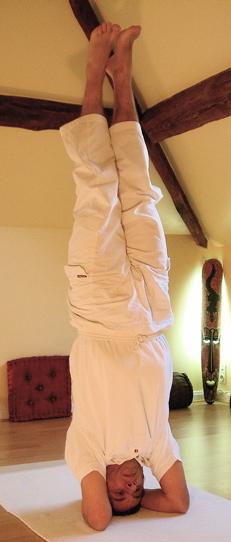
If the whole body of yours is supported on your forearms; if your head is touching the floor; and your feet are facing straight to the sky; you must be in the state of ‘Sirsasana’, or ‘Headstand Yoga Posture’.
As this posture makes us to stand on the strength of our head, it is named Headstand Posture. Sanskrit word for it is Shirshasna, but it is pronounced as ‘Sirsasana’ or ‘Sirshasana’, too.
While being on mere support of the head, we can take the assisting support of our palms or ankles as shown in these two illustrated postures.As this postures makes us to stand on the strength of our head it is named as Sirshasana, the Head Stand Posture. While being on mere support of the head, we can take the assisting support of our palms or ankles as shown in these two illustrated postures.

How to Do Shirshasana


Here is step-by-step guidance for doing this pose. It is one of the most difficult postures. But it can be done in two stages.
Stage One
  • Come to kneeling position and put your forearms fully touching the floor. The fingers are to keep interlaced.
  • Put your head on the area cupped by your fingers and the forearms.
  • Then raise your waist as straight as possible. You can do it by taking your feet closer to head. It will send your hips over your shoulder. In this position your body would make the shape of a triangle on floor. This posture is an independent yoga posture. It is called Raja Grivasana. You can stay in this pose as long as you like.
Stage Two
  • After you feel comfort in Raja Gricasana, the last pose as shown above, you would try lifting your feet and dragging knees near to your chest.
  • Let the feet be settled for a while.
  • The slowly and steadily try raising legs up. You should not worry if you fail to do it for one or two days.
  • After the legs are straight and upward, the ‘Headstand Posture’ is completed. You are to remain in this pose for ten seconds.
  • When you decide to end the pose, first put your one of the legs on the floor and then another.

Benefits of Doing Sirsasana

Like all other postures, it increases the flow of blood to our head and brain. This in turn would result in improvement of intellectual functions. It would help in increasing our memory.
It would help us to get relief from back pain or pain in leg and thigh muscles.
A person suffering from Sciatica would also be benefited. But in that case, this posture must be done in presence of a trained teacher. (Image courtesy By Joseph RENGER [GFDL, CC-BY-SA-3.0 or CC-BY-SA-2.5-2.0-1.0], from Wikimedia Commons)

Twitter Delicious Facebook Digg Stumbleupon Favorites More

 
Design by Free WordPress Themes | Bloggerized by Lasantha - Premium Blogger Themes | Grants For Single Moms